Template creation
:::note Placeholder page The confirmed console copy and screenshot below are real; steps and fields around them are still being verified against a full capture-and-deploy pass. :::
From the console's own template library:
A template is a hardware profile, a guest customisation profile, and a generalised VHDX held on storage. Capture one from any VM that is powered off ("Capture as template..." on the VM), then deploy from it: the image is copied, the guest's unattend is written into the copy, and the new VM's desired state is authored once the copy lands — from then on it is an ordinary managed VM. A template on a cluster's shared storage deploys anywhere in that cluster; one on a host's local volume deploys only to that host.
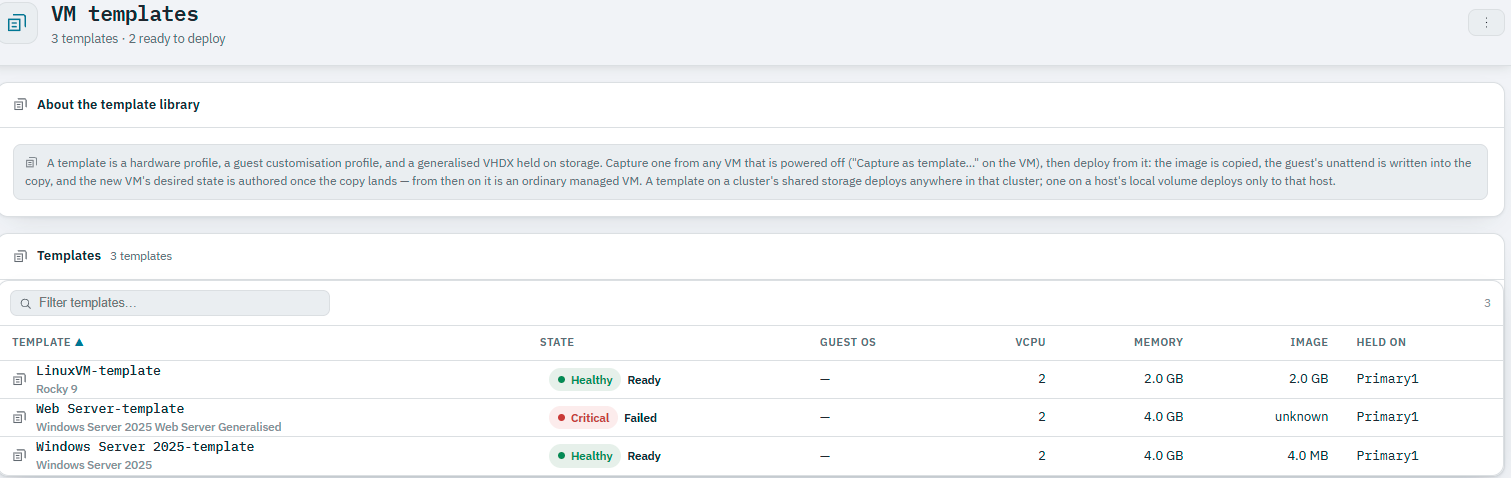
Creating a template from an existing VM
- Power off the source VM.
- From the VM's detail page, use Capture as template....
- Once the capture task succeeds, the template appears in VM templates with its guest OS, vCPU/memory profile, image size, and which cluster or host it is held on.
Creating a VM from a template
Deploying from a template asks for the values a template intentionally leaves open — hostname, IP configuration, target host or cluster, and resource sizing — then creates the VM as a normal desired-state object. From that point it is reconciled exactly like any other VM; the template is only how it was seeded.
Where a template can deploy
This is the one rule worth remembering: a template on a cluster's shared storage deploys anywhere in that cluster; one on a host's local volume deploys only to that host. Where you capture it decides where it can go.
Templates and ROBO sites
A template created centrally can be deployed at any site the centre manages, including a remote-office/branch-office (ROBO) site with only one or two hosts — the same template, deployed locally by that site's agent(s), without duplicating the definition per site.